
How I Photographed the Partial Solar Eclipse Above Ghent
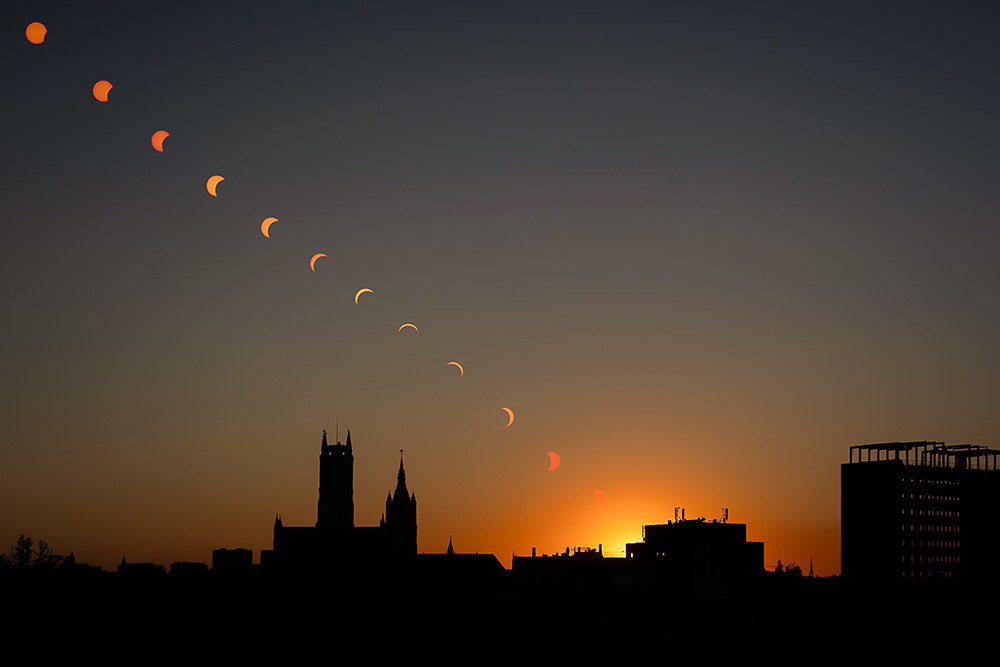
Partial Solar Eclipse Above Ghent, 12/08/2026. © Martin Corlazzoli
Photographing a partial solar eclipse above Ghent was a first for me. This is the story behind the image — from finding the right location and planning the sun’s trajectory with PhotoPills to shooting the eclipse and creating the final composite in Photoshop.
The shot
A friend and fellow photographer, Stijn (@travelformotion), reached out to ask if I was planning to photograph the eclipse. He already had a location in mind. That was the first step: finding a location where the towers and the eclipse would roughly align. To plan this, we used the PhotoPills app. In the end, the rooftop of an apartment building became our shooting location.
Once on the roof, I set up my camera, a Sony Alpha A74 combined with a 24-70mm 2.8 lens, on a tripod and worked out the desired composition. Using PhotoPills, I was able to preview the sun’s trajectory and estimate its path during the eclipse, allowing me to fine-tune the composition accordingly.
I then attached a solar filter to my lens to protect my camera’s sensor, similar to the way eclipse glasses protect your eyes. The downside was that I could no longer see my original composition through the viewfinder — only the sun was visible.
From 7:13 PM until 9:15 PM, I took a photograph of the sun every five minutes.
For the final shot, I removed the solar filter and photographed the Ghent skyline. By then, the sun had already disappeared behind a building, making it safe to photograph without the filter.
Post-processing
I opened all the images as separate layers in Photoshop, using the Ghent skyline as the base layer. I then placed the different images of the sun on top and removed the black areas from each frame with a simple click in Photoshop, leaving only the sun visible.
This allowed me to combine all the individual positions of the sun into a single image, creating the final composite.
Looking back
This was the first eclipse I had ever photographed and, to be honest, I wasn’t immediately convinced by the result.
You spend two hours photographing more or less blindly. Once the solar filter is on, your entire composition disappears, and all you can see through the viewfinder is the sun.
Still, I learned a lot that evening, and there are definitely a few things I would do differently next time.
For one, I made my initial composition too wide because I wanted to play it safe and leave enough room around the subject. In the end, that margin was too generous, and I had to crop quite heavily in post-processing to achieve the final composition. That inevitably meant losing some resolution.
I would also take the final skyline shot later, once the sun is completely below the horizon and the sky has become an even blue. That would create a cleaner and calmer final image and allow the different elements of the composite to blend together even better.
A first attempt, a lot of lessons learned — and hopefully not the last eclipse I’ll photograph. 🌒 📸
#Photography #EclipsePhotography #SolarEclipse #Ghent #PhotoPills #Photoshop #SonyAlpha